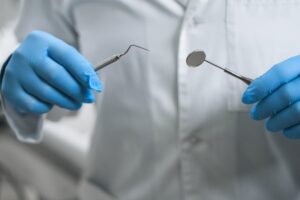

If you are a licensed dental professional, such as a dentist, dental hygienist, or dental assistant, you should know that certain actions can lead to disciplinary action against you by the Texas State Board of Dental Examiners (TSBDE). If you are in this situation, an experienced dental license defense attorney at Bertolino LLP will work to keep you informed of your rights and responsibilities during your disciplinary proceedings.
Common Grounds for Disciplinary Action Against Dentists
According to the TSBDE, The Journal of the American Dental Association (JADA) published a recent study concerning general dentists in Texas. After analyzing over 1,000 disciplinary actions over 16 years, the JADA study found that the most common grounds for disciplinary action against dentists include the following:
- Recordkeeping (39%) violations included missing treatment notes, incomplete medical histories, and failure to document vital signs or informed consent.
- Treatment-related infractions (23%) involved failure to meet the standard of care, overtreatment, and iatrogenic trauma.
- Ethics and professionalism violations (23%) included improper billing, prescription errors, and personal conduct issues.
- Diagnostic errors (9%) involved misdiagnosis, failure to refer, or inadequate diagnostic workups.
- Licensing and renewal issues (6%), such as dentists who forgot to renew their licenses.
Other grounds for disciplinary proceedings against dental professionals include:
- Conviction of a misdemeanor involving fraud or a felony offense;
- Failure to treat a patient according to the applicable standard of care;
- Negligence in performing dental services that causes injury to a patient;
- Failure to use proper diligence in the practice of dentistry or dental hygiene;
- Failure to safeguard patients against avoidable infections;
- Commission of dishonorable conduct in the practice of dentistry or dental hygiene;
- Licensure by fraud or misrepresentation;
- Engagement in deception or misrepresentation in soliciting or obtaining patronage;
- Licensure that has been suspended or revoked in another state or facing a reprimand under the disciplinary rules of that state;
- Unauthorized practice of dentistry or otherwise permitting an unlicensed person to practice dentistry in an office under the dentist’s control or management;
- Addiction to alcohol or drugs or improperly obtaining, possessing, or distributing habit-forming drugs or narcotics;
- Violation or refusal to comply with a law regulating dentists or dental hygienists;
- Physical or mental incapacity that prevents the safe practice of dentistry; or
- Legal insanity.
Based on the results of the JADA study, the TSBDE concluded that dentists who are proactive in the following areas are less likely to end up facing disciplinary charges:
- Ensure that your charts contain all information and documentation required by state laws and TSBDE rules.
- Keep patient care as the focus of your practice.
- Know the applicable laws and regulations that pertain to your profession.
- Don’t allow licensing renewals to slip through the cracks.
Investigation of Disciplinary Complaints
When the TSBDE receives a complaint about a dentist or dental professional, it must determine whether the complaint falls within its jurisdiction. The TSBDE only handles complaints that allege violations of the Dental Practice Act and TSBDE rules and regulations.
If the TSBDE determines that the complaint falls within its disciplinary authority, it will investigate whether evidence shows that a violation occurred. Sufficient evidence of a violation may result in the TSBDE filing formal disciplinary charges against the licensee.
Disciplinary Actions that TSBDE Can Impose
Filing disciplinary charges against a licensee requires notice to the licensee and the opportunity to attend a hearing. If the TSBDE finds that the licensee violated a law or rule related to the profession of dentistry, it can impose various sanctions, including license revocation or suspension, placement on probation under certain conditions, a reprimand, a warning letter, and/or an administrative penalty. Tex. Occ. Code §263.002(a). A licensee whom the TSBDE places on probation can require certain conditions of completing probation under Tex. Occ. Code §263.005. These conditions may include the licensee regularly reporting to the TSBDE on matters related to the grounds for probation, limitations on areas of practice, and completing continuing education to acquire the necessary degree of skill in the areas related to the disciplinary charges.
In many cases, TSBDE will resolve minor violations that do not involve patient care by assessing an administrative penalty. However, serious violations often result in more severe sanctions, including probation, suspension, or revocation.
Complete a Case Evaluation form now
TSBDE can accomplish disciplinary action through an agreed settlement order or through a board order following an administrative hearing. Upon reviewing the recommendations of the administrative law judge after a hearing, a majority of the TSBDE must approve a disciplinary sanction against a licensee.
Allow Bertolino LLP, to Help You with Your Professional Disciplinary Case
Understanding the implications of disciplinary proceedings for a licensed dental professional can be critical to your future. Disciplinary proceedings can result in negative consequences, including suspending or revoking your dental license. When you face disciplinary proceedings, you need an experienced dental professional license defense attorney to assist you. Contact Bertolino LLP today at (512) 515-9518 or visit us online.
Call or text (512) 515-9518 or complete a Case Evaluation form